Physical Address
304 North Cardinal St.
Dorchester Center, MA 02124
Physical Address
304 North Cardinal St.
Dorchester Center, MA 02124

Skin cycling is a four-night rotating skincare routine that strategically alternates between active ingredients and rest. The whole idea is that instead of layering powerful products on your skin every single night, you give your skin designated nights to work and designated nights to recover.
If you’ve spent any time on skincare TikTok lately, you’ve probably seen the term “skin cycling” floating around. It sounds technical, maybe even a little intimidating but I promise, it’s one of the simplest and most effective shifts you can make to your nighttime routine.
Skin cycling is a four-night rotating skincare routine that strategically alternates between active ingredients and rest. The whole idea is that instead of layering powerful products on your skin every single night (which, it turns out, most of us have been doing wrong), you give your skin designated nights to work and designated nights to recover. Think of it like a workout schedule for your face — you wouldn’t lift heavy every day without a rest day, and your skin barrier feels the same way.
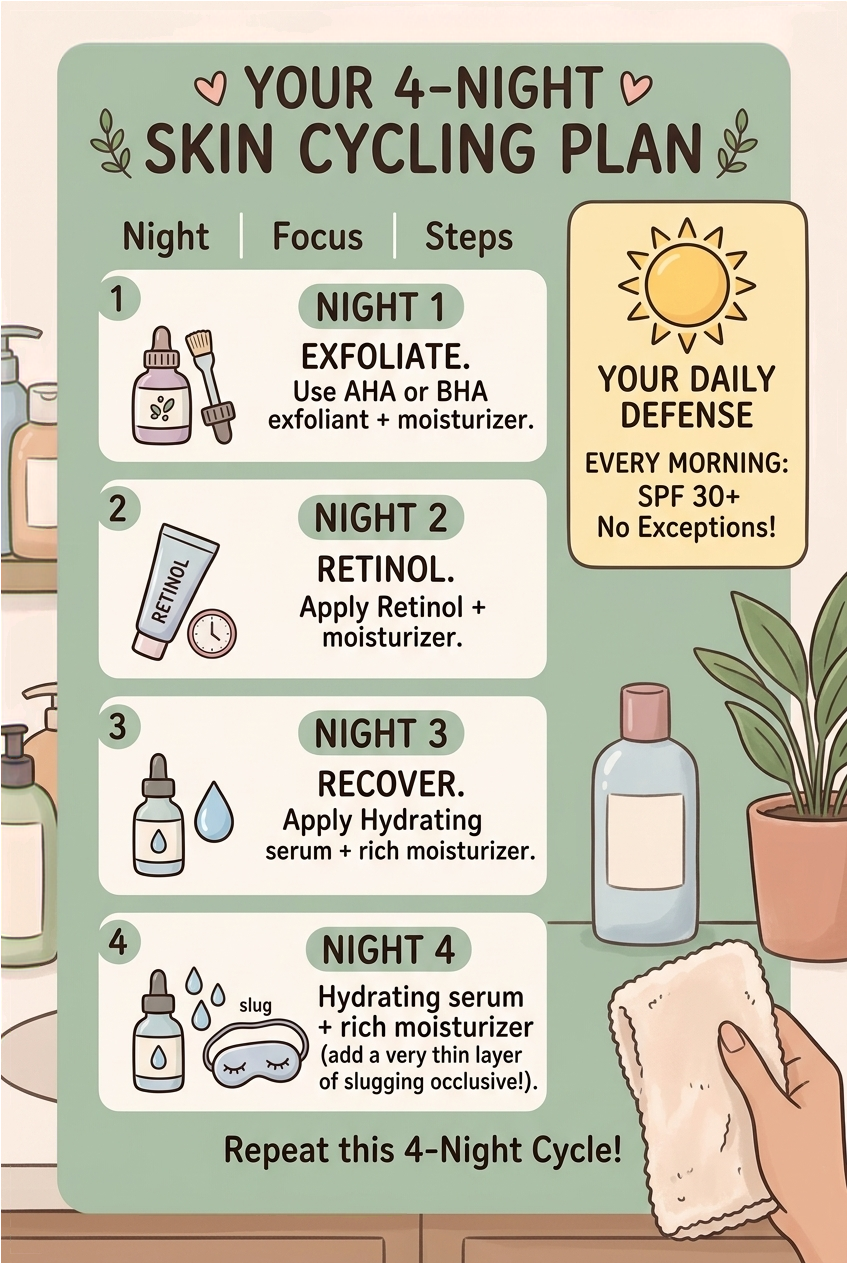
The Classic 4-Night Cycle Looks Like This:
Night 1 — Exfoliation Night This is when you use a chemical exfoliant — typically an AHA like glycolic acid or a BHA like salicylic acid. Exfoliants slough away dead skin cells, smooth texture, and prep your skin to better absorb what comes next. You use it, you let it do its thing, and then you’re done. No retinol on top, no stacking — just exfoliant and a gentle moisturizer to finish.
Night 2 — Retinol Night The night after exfoliation, your skin is primed and ready. This is when you apply your retinol (or retinoid). Because you exfoliated the night before, your retinol can penetrate more effectively — meaning you get better results without having to use a stronger formula. Again, keep the rest of your routine simple. Cleanser, retinol, moisturizer. That’s it.
Night 3 — Recovery Here’s where skin cycling earns its reputation. Instead of reaching for another active, you put everything down and focus entirely on repair. Think barrier-loving ingredients: ceramides, hyaluronic acid, peptides, a rich moisturizer. Your skin has been working hard the last two nights — now you’re just giving it what it needs to heal and rebuild.
Night 4 — Recovery (Again) Yes, two full nights of recovery. This is the part most people want to skip, and it’s also the part that makes the whole method work. Retinol and exfoliants can be taxing on the skin barrier, even when used correctly. That second recovery night ensures you’re not undoing the progress by jumping back into actives too soon. After Night 4, you start the cycle again from the top.
Where Did Skin Cycling Come From?
Skin cycling was popularized by New York-based dermatologist Dr. Whitney Bowe, who introduced the concept on TikTok in 2022. Her videos went massively viral — and for good reason. In a world where skincare routines had become increasingly complicated (10-step routines, layering five actives at once, “slugging” on top of retinol), skin cycling offered something refreshing: a clear, structured method that actually made biological sense. It wasn’t just a trend — it was grounded in how skin regenerates and recovers, and dermatologists largely got behind it.
The idea spread quickly because it solved a problem a lot of people didn’t even realize they had: over-exfoliation and retinol irritation from using too much, too often. More on that in the next section.
The Simplest Way to Think About It
If you want to sum it up in one sentence: skin cycling is about being intentional with your actives so they can do their job without burning out your skin barrier in the process. You’re not using fewer products — you’re using them smarter.

So now that you know what skin cycling actually is, the real question is — why has everyone lost their mind over it?
The short answer is that it works. But the longer answer is a little more interesting, because skin cycling didn’t just go viral because it’s effective. It went viral because it solved problems that millions of people were quietly suffering through and didn’t have a name for.
It Protects You From Yourself
Here’s an uncomfortable truth: most skincare enthusiasts — especially beginners — are using too many actives, too often. Retinol four nights in a row. Glycolic acid toner every morning. A vitamin C serum, an exfoliating cleanser, and a retinol on the same night. It sounds like dedication, but what it actually creates is a compromised skin barrier — and a compromised barrier means redness, flaking, sensitivity, breakouts, and that tight, irritated feeling that no moisturizer seems to fix.
Skin cycling essentially builds guardrails into your routine. It makes it structurally impossible to over-exfoliate or overdo retinol, because the method itself tells you when to stop. For people who tend to go overboard (guilty), that structure is genuinely life-changing.
It Makes Retinol Approachable
Retinol is widely considered one of the most effective skincare ingredients available — dermatologists recommend it for everything from fine lines to acne to uneven texture. But it also has a reputation for being brutal on skin, especially in the beginning. The “retinol purge,” the peeling, the sensitivity — it scares a lot of people off before they ever give it a real chance.
Skin cycling changes that. By sandwiching retinol between an exfoliation night and two full recovery nights, you dramatically reduce the chance of irritation. Your skin gets the benefit of the retinol without the punishment of using it too frequently. For anyone who has ever wanted to try retinol but felt nervous, skin cycling is genuinely one of the best entry points.
It Works With What You Already Have
One of the most underrated things about skin cycling is that it doesn’t require you to go out and buy a completely new routine. Chances are you already have an exfoliant, a retinol or retinoid, and a moisturizer sitting in your cabinet. Skin cycling just reorganizes how and when you use them. In a beauty landscape that constantly pushes you to buy more, there’s something really appealing about a method that tells you to use less.
It Fits Into the Bigger “Skin Minimalism” Shift
Skin cycling didn’t come out of nowhere. It arrived right as a broader cultural shift was happening in skincare — a collective pulling back from the maximalist, 10-step routine era and a return to simplicity. People were burning out their skin barriers and their wallets trying to keep up with every new product drop, and the backlash was inevitable.
The new conversation in skincare is about doing less, better. Fewer products that actually work. Routines built around biology, not trends. Ingredients that support your skin barrier rather than constantly stripping and stressing it. Skin cycling fit perfectly into that moment because it’s not about adding more — it’s about being strategic with what you already use.
It gave people permission to simplify, and that permission was long overdue.
Skin cycling gets a lot of praise, and most of it is deserved — but like anything in skincare, it isn’t a one-size-fits-all solution. The good news is that it works for a surprisingly wide range of people. Here’s how to know if you’re one of them.
You’re New to Skincare Actives
If you’ve been standing in the Sephora aisle staring at retinols and exfoliants wondering where on earth to start, skin cycling was practically made for you. It removes all the guesswork. Instead of trying to figure out which actives to use, in what order, on which nights, and how often — the method hands you a ready-made framework. You follow the four nights in order, you repeat, and you let your skin adjust gradually. It’s the training wheels of active skincare, and there’s absolutely nothing wrong with that.
You’ve Experienced Irritation, Redness, or Peeling Before
If you’ve tried retinol in the past and gave up because your skin freaked out, there’s a good chance the issue wasn’t the retinol itself — it was the frequency. The same goes for exfoliants. Using them too often, or on top of each other, is one of the most common causes of barrier damage. Skin cycling spaces everything out deliberately, which gives reactive or sensitized skin the breathing room it needs to actually tolerate and benefit from actives over time. Many people who swore off retinol entirely have reintroduced it successfully through skin cycling.
You’re a Skincare Enthusiast Who’s Been Overdoing It
You know who you are. The one with twelve serums on the bathroom shelf and a routine that takes forty-five minutes. If your skin has started feeling more irritated than glowy lately, skin cycling is worth trying as a reset. Stripping your routine back to the four-night structure — even temporarily — can help your barrier recover and give you a clearer picture of what your skin actually needs versus what you’ve just been conditioned to buy.
You Want to Start Retinol But Have Been Scared To
Retinol has a reputation that precedes it, and not always in a flattering way. The purge period, the flaking, the “it gets worse before it gets better” warnings — it’s a lot. But the evidence behind retinol is too strong to ignore if your skin goals include texture, tone, fine lines, or acne. Skin cycling gives you the slowest, gentlest possible on-ramp. You’re using it just one night out of four, with a full exfoliation prep the night before and two recovery nights after. If there was ever a low-risk way to try it, this is it.
A Few Cases Where You Should Check With a Dermatologist First
Skin cycling is gentle by design, but there are some situations where it’s worth getting a professional opinion before diving in.
The Bottom Line
If you have relatively normal, combination, oily, or even mildly sensitive skin and you want a smarter way to use the actives you already have — skin cycling is a very reasonable place to start. It’s low risk, well-structured, and grounded in real dermatological logic. The people it helps most aren’t a niche group. They’re the majority of people standing in front of their bathroom mirror trying to figure out what their skin actually needs.

Okay, you’re convinced. You want to try it. Heres everything you need to know — broken down night by night, with product recommendations at every step so you’re not left guessing.
The most important thing to know before you begin: start simple. Resist the urge to layer extra products on top of the framework, especially in your first cycle. Give your skin a chance to respond to the basics before you start adding things back in. Sometimes less is more.
Every Night — The Non-Negotiables
Before you get to the actives, your routine always starts the same way:
After cleansing, your routine splits depending on which night you’re on.
Night 1 — Exfoliation Night
After cleansing, apply your chemical exfoliant to dry skin and let it absorb. Then follow with a simple, fragrance-free moisturizer to seal everything in. That’s your whole routine for the night — no serums stacked on top, no retinol, nothing extra.
What to look for in an exfoliant: You want either an AHA (alpha hydroxy acid) like glycolic or lactic acid, which works on the surface to smooth texture and brighten, or a BHA (beta hydroxy acid) like salicylic acid, which goes deeper into pores and works well for oily or acne-prone skin. If you’re new to exfoliants, start with a lower percentage and work your way up.
Product recommendations:
Night 2 — Retinol Night
After cleansing, apply your retinol to skin that is fully dry — this is important, as applying retinol to damp skin can increase irritation. Use a pea-sized amount across your whole face, let it absorb for a few minutes, then follow with your moisturizer.
If you’re brand new to retinol, consider the “sandwich method” for your first few cycles: apply a thin layer of moisturizer first, then retinol, then moisturizer again on top. It softens the delivery and significantly reduces the chance of peeling or redness while your skin adjusts.
What to look for in a retinol: Start low — 0.025% to 0.1% is plenty for beginners. You can always increase the strength once your skin has built up tolerance. Don’t let anyone talk you into starting strong.
Product recommendations:
Nights 3 & 4 — Recovery Nights
These two nights are all about one thing: giving your skin barrier everything it needs to repair and rebuild. Put the actives away entirely. Your routine should feel almost boring — and that’s exactly the point.
Focus on ingredients like ceramides, hyaluronic acid, niacinamide, and peptides. These are barrier-supporting, hydrating, and anti-inflammatory — the opposite of everything you used on Nights 1 and 2.
A simple recovery night routine:
Product recommendations:
One More Thing: SPF Every Single Morning
This isn’t optional. When you’re using exfoliants and retinol — even just a couple nights a week — your skin is more vulnerable to UV damage. Skipping SPF while skin cycling is like leaving the house in the rain without a jacket. A broad-spectrum SPF 30 or higher every morning, rain or shine, is the non-negotiable that holds the whole routine together.
SPF recommendations:
So, is skin cycling worth it? Honestly — for most people, yes. It’s not a miracle cure and it won’t transform your skin overnight, but that’s kind of the whole point. Skin cycling works precisely because it slows you down, gets you out of the habit of piling on products, and gives your skin the structure and breathing room it actually needs to thrive.
If you’ve been struggling with irritation, stuck in a skincare rut, or just feel like your routine has gotten a little out of control — this is one of the simplest resets you can make. Four nights, a few products you likely already own, and a little patience.
Start with one cycle. See how your skin feels by Night 4. That’s it.